
Islamic Schools: Too Loud in Amsterdam, Too Late in Oslo
Since 2020, Norway’s parliament has wanted to stop Quran schools from keeping children overnight. On September 23, the government declared a ban impossible, then changed its mind ten days later, after former pupils described their childhood there. In Amsterdam, the State tried the opposite method on an Islamic school, and was ordered to pay damages.

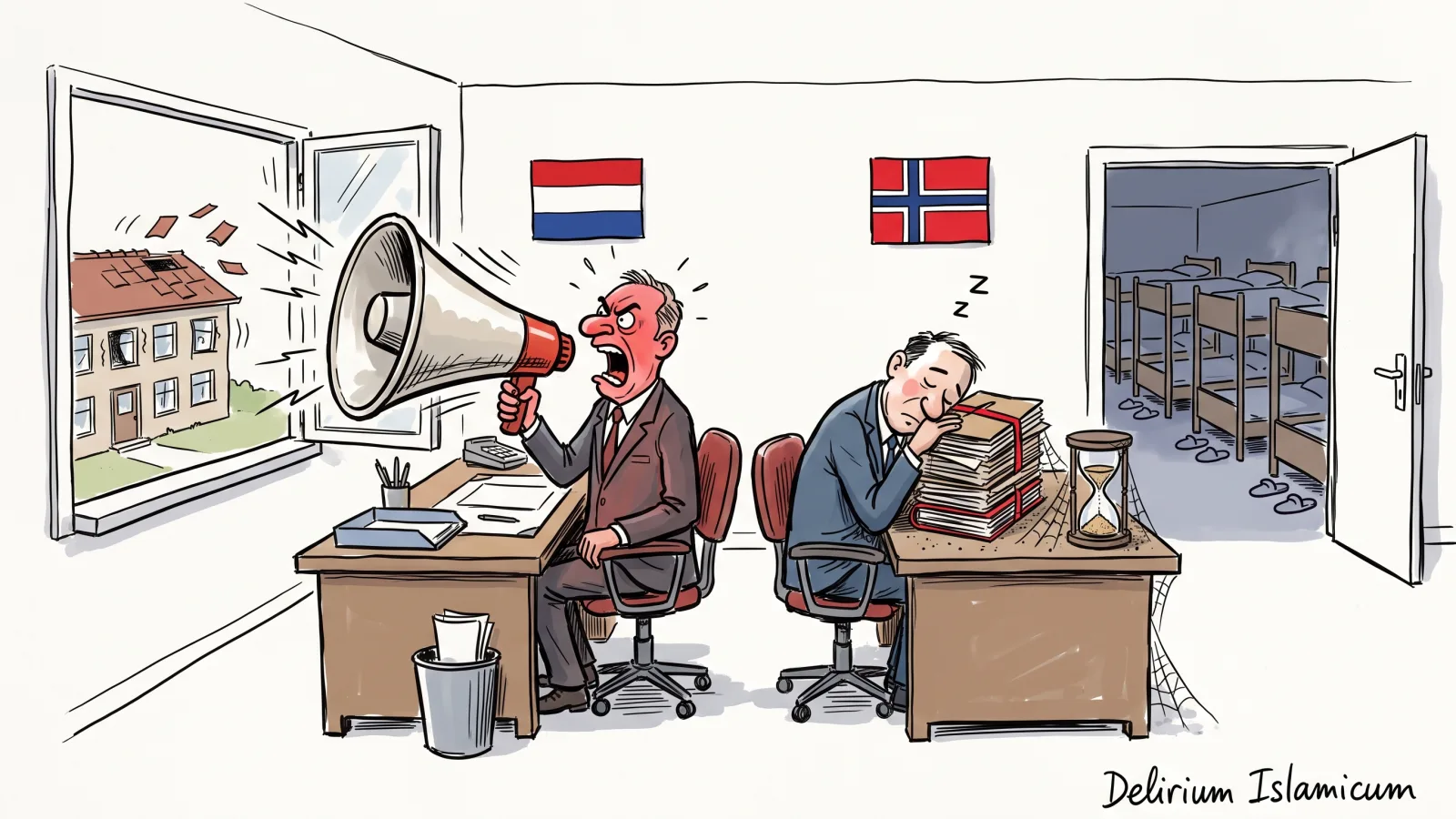
Six years of homework
On April 14, 2020, Norway's parliament, Labour included, asked the government for a law banning regular after-school programs where children stay overnight for long periods. The stated aims: fighting segregation, parallel societies, negative social control and radicalization. The program that prompted the vote, NRK recalls, was the Quran school of the Islamic Cultural Centre.
On September 23, 2026, the minister for children and families, Lene Vågslid, dropped the ban: it could amount to discrimination based on religion under the European Convention on Human Rights, and would also hit programs parliament never meant to stop. Ten days later, she announced the opposite: a working group of six ministries will study a ban, or stricter rules. There is still no bill. The minister now speaks of a legal vacuum, the very one parliament asked the government to fill in 2020.
Homework help, with a dormitory
The Islamic Cultural Centre, registered in 1992 and based in Drammen, has about 4,000 members and belongs to the Süleymancı movement, a conservative Sunni current from Turkey. It describes its overnight program as play, homework help and physical activity. Former pupils describe something else. An imam's daughter fled at 15; now 19, she lives at a secret address under a hidden identity, Aftenposten reports. A woman in her thirties, kept there against her will for four years in the 2000s, recalls no friends outside the community, no sport, checks on how her hijab was tied, and routines that left children too tired to follow at school. She has reported the community to the county governor and speaks of a "child prison".
"Being in the congregation was like military service. But we were children."— A former resident, now in her thirties, to NRK
Another former pupil is most upset that the state pays for it. According to Aftenposten, the community has received more than 39 million kroner in public grants, and hopes to turn a school building it bought in 2014 into an imam training centre, with overnight stays. It rejects the criticism and says its activities are voluntary. The county governor is still reviewing its answers to more than 30 questions.
Liberal MP Abid Raja asks whether Norway would have waited this long if white children had been tucked away for years in parallel institutions.
"Shouldn't the same freedoms also benefit Muslim children?"— Abid Raja, Liberal MP, to NRK
The Islamic Council of Norway, for its part, warns against collective restrictions based on individual cases.
Amsterdam, the loud method
The Netherlands tried the opposite approach. In 2019, its intelligence and counterterrorism services accused the Cornelius Haga Lyceum, a state-funded Islamic secondary school in Amsterdam, of anti-democratic Salafist leanings, and linked its directors to the Caucasus Emirate, a Chechen jihadist group. The mayor froze the city's funding, and the education minister tried to remove the board and cut off the school's state money.
The courts disagreed. In November 2019, in an interim ruling, the Council of State found that the minister had not followed his own rules. In September 2024, a court in The Hague ruled that the State had acted unlawfully by creating the false impression that the school tolerated anti-democrats, and ordered it to compensate the school's board.
"The incorrect picture the State created had very negative consequences for the school's reputation."— The Hague District Court, September 4, 2024
The real scandal: the exam results
The State had sounded the terror alarm. In July 2026, the education inspectorate found a far more ordinary failure, the same one it had already found in 2019: mismanagement. Over three years, about 35% of its pupils in the mavo stream, the four-year general track, passed their final exams, against about 91% nationally. The board has one year to fix it, and calls the report one-sided.
In Amsterdam, the State raised its voice too early. In Norway, children sleep at the Quran school, and the law has been asleep on the government's desk since 2020.
Sources
Countries
Keywords
Read also
Aulnay's Imams Didn't Just Quote the Quran. They Curated It.
A prayer hall in Aulnay-sous-Bois, north of Paris, was ordered shut for six months, and the association running it has since been dissolved. Its preachers justified the killing of a Quran burner, attacked Jews and nonbelievers, and ranked Shiites below pigs and dogs. The mosque's lawyer suggests France now punishes quoting the Quran. The court disagreed.

Terengganu Appeals Against Leniency, Wins Six Strokes Each
On September 15, the syariah appeal court of Terengganu, in Malaysia, sentenced a man of 41 and a woman of 20 to six strokes of the rattan each, for having twice been caught alone with someone of the opposite sex. The prosecutor had found the fine too lenient. The caning is due by mid-October, and the state now has nine mosques licensed for the purpose.
Caliphate Closed, Says Trump. Dresden Man Accused of Trying to Join
The last American troops left Iraq on September 30, a departure Donald Trump hailed as the end of the caliphate. Two days later, special forces arrested a 37-year-old man in Dresden, accused of trying to join the Islamic State and of preparing a terrorist offence. The population, prosecutors assure, was never in concrete danger.