
Family Values, Caliphate Edition
In October, the Paris special assize court tried three French families who moved to the Islamic State, children included. The mothers got between five and eleven years. The children had already served their sentence.

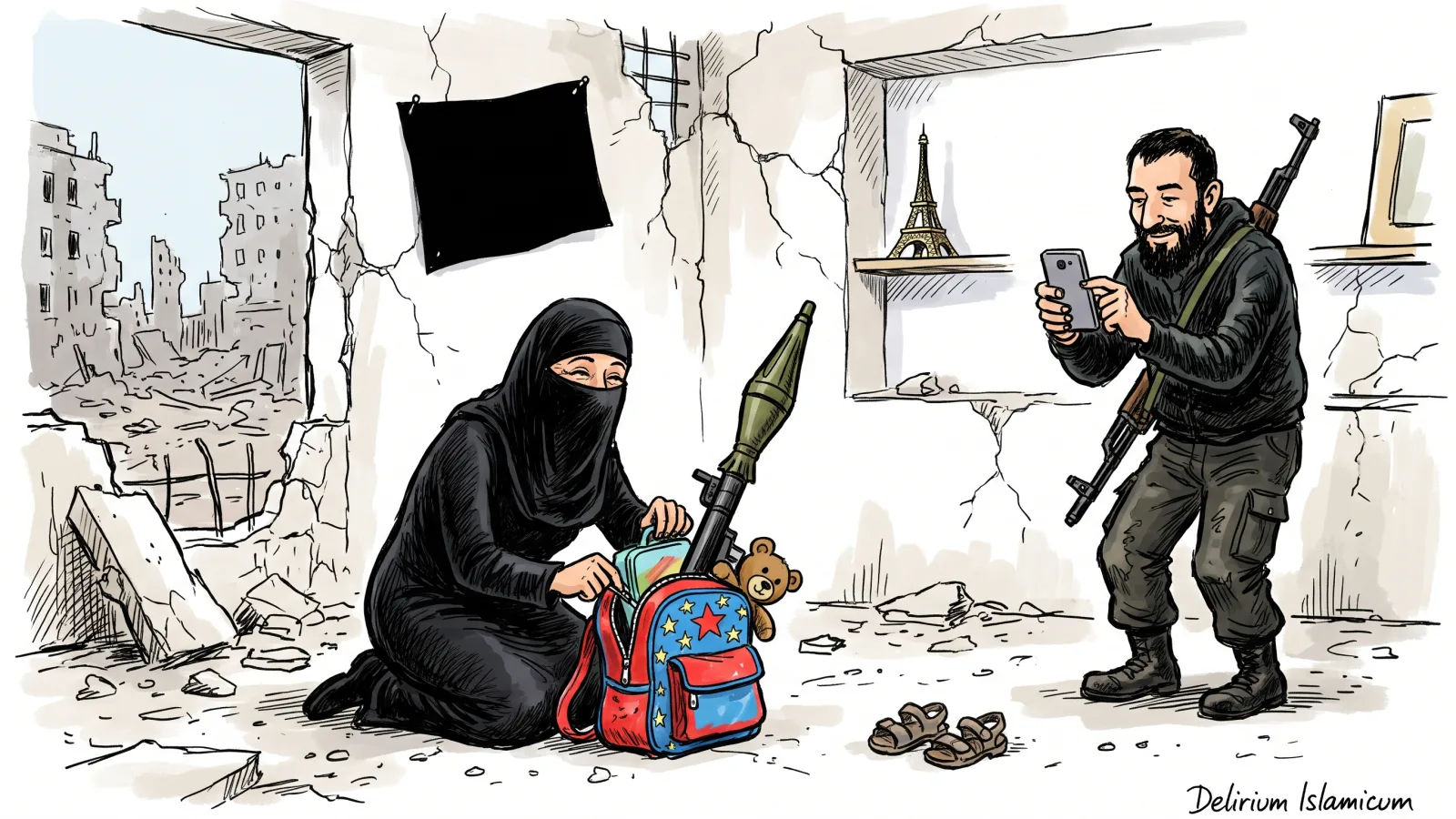
A clan, a sect, a caliphate
Between May and September 2014, 23 members of the Tahar Aouidate family, 15 of them adults, left Roubaix, in northern France, for the Islamic State: the parents, most of the daughters, their husbands and the grandchildren. The tour operator was the only son, Fodil, who had already been to Syria: the "guru" of a family his sister now calls a sect. Radia Selma, the youngest, went first. At her trial, which opened on October 14, she described a home where her brother ruled his sisters with their mother's blessing, and checked her clothes and make-up before and after school, shouting "Inspection!".
In Syria, she had two children with a high-ranking Tunisian IS fighter, now aged 11 and 9 and in state care, and, according to investigators, led a fairly comfortable life until 2016 or 2017. An investigator told the court that she ended up with a view of Islam more radical than the Islamic State's own. The family's balance sheet: her mother, a sister and four brothers-in-law died in Syria, other relatives are reportedly still held in Kurdish-run camps, and Fodil, sentenced to death in Iraq in 2019, is serving life there. The two sisters who stayed in France were convicted of financing terrorism for sending money. Only Radia Selma and a niece came back.
On October 16, the court sentenced her to eight years for terrorist conspiracy, one less than the prosecution sought; she had already spent five and a half years in detention. The court said it was judging a woman, not a family, and did not see her as an IS die-hard. For the prosecutor, the ideological poison had entered the family through Fodil, and the family drank it to the dregs.
"You have your full place in our society in the relatively near future."— The presiding judge to Radia Selma Tahar Aouidate, Paris special assize court, October 16, 2026
Toddler on board
A couple from Isère, in the French Alps, drew close to IS in Grenoble in January 2015 and left in June with their son, born in January 2014: a coach to Switzerland, a plane to Turkey, then Syria and Iraq. According to France's anti-terrorism prosecutors, the father went through indoctrination and weapons training camps, then fought. Presumed dead since 2016, though his death was never established, he was sentenced on October 13 to 20 years in absentia, with an arrest warrant. The mother is said to have married three more IS fighters between 2016 and 2023, the year she came back to France. She got five years, to be served at home with an electronic tag. Both were also convicted of failing their duties as parents by taking a toddler to a war zone.
Rocket launcher at seven
Vanessa Bérard, 38, from the Lyon area, whose trial opened with her own childhood of foster care and abuse, left at the end of 2013 with her son, 5, and her daughter, 2, drawn by Emilie König, the poster girl of French jihadists. In Syria, she married the jihadist Mohamed Skalab after a ten-minute meeting, then shot and seriously wounded him in their Raqqa flat in the spring of 2014: to stop him from deserting, said the prosecution; to defend herself from his beatings, said she. He deserted anyway, and a Tunisian fighter was imposed on her. In 2017, her two daughters, one of them born in Syria, were killed in a bombing. Arrested at the fall of Baghouz in 2019, she spent more than three years in a Kurdish-run camp with her two sons before being repatriated in October 2022.
Her eldest son, now 17, told the court that violence was the normal setting of his childhood: public beheadings, women whipped, couples thrown from buildings and stoned. He threw stones too. At seven, he spent eight months in Iraq, where a jihadist taught him to fire a rocket launcher. A police officer told the court that of the 500 to 550 children of French jihadists in IS territory, about 150 died. On October 23, Vanessa Bérard got 11 years. The prosecution had asked for 16.
"I stole his childhood."— Vanessa Bérard, at her trial, October 2026
A genre, not a fluke
Family jihad is now a genre at the Paris special assize court. After the big attack trials, French justice has turned to the "revenantes", the women who joined IS and came back: according to RFI, they account for 18 of the 23 terrorism trials scheduled at the assize court this year. Women made up nearly a third of the roughly 1,500 French nationals who went to Syria and Iraq, and 176 of the 395 adults who returned; 56 have already been convicted. Researchers quoted by RFI call France the toughest country in Europe on these women.
The record still belongs to the Clains, the family of the two brothers whose voices claimed the November 13, 2015 Paris attacks for IS: more than 20 of them, four generations, left in 2014 and 2015. In September 2025, the same court sentenced their niece Jennyfer to 11 years. She had been married off religiously at 15, her mother signing her travel authorisation, "as if I had 'given' her", the mother later admitted. Jennyfer took four children to Syria, had a fifth in Raqqa, and admitted exposing them to videos of atrocities and public displays of severed heads.
Meanwhile, in Baghdad
Not every child of the caliphate gets a French court. Forty-seven French nationals long held in Kurdish-run camps in Syria have been transferred to Iraq, where joining a terrorist group is a crime even for those who never fought. Among them, says one of their lawyers, are "young adults": children taken to Syria by their parents. On October 27, the first seven were sentenced. Six got life, which means 20 years in Iraq, the judge having spared them the death penalty because of their youth.
"To give you a chance... to straighten the course of your life."— The Iraqi judge to six French IS members sentenced to life, Baghdad, October 27, 2026
The seventh, aged 24, was taken to Syria by his mother more than ten years ago. He got 15 years. France has held since 2019 that its jihadists should be tried where they committed their crimes, while opposing the death penalty. His lawyer, Marie Dosé, accuses France of accepting this fate for children turned adults who bear no responsibility for their parents' choices. Their lawyers also report torture and forced confessions, and some were banned from entering Iraq after denouncing inhuman treatment.
In Paris, the mothers who took their children to the caliphate got five to eleven years. In Baghdad, a son taken there by his mother got fifteen.
Sources

Read also

Adam and Eve, Expelled From Google’s Garden
On October 9, Google removed Adam and Eve, an Iranian matchmaking app that listed girls as young as 13 as prospective wives, for violating its policies. At home, the app holds a state licence and has been promoted on state television. On Google Play, it was rated suitable for everyone.

Sworn to Hamas, Expelled for ‘Resentment’
Thirteen North Africans were flown out of Italy on a charter. Twelve had criminal records. The thirteenth, a student in Trieste, had a social media account and, according to Il Tempo, an oath of allegiance to Hamas’s armed wing.

Hymns to Merah, Answers from the Bench
In early October, French teenagers were filmed chanting a rap song celebrating Mohammed Merah and Salah Abdeslam, at a school blockade and on a church altar. The rapper goes on trial on October 21; his manager firmly condemns the glorification of terrorism. Meanwhile, appeal courts toughened the sentences of the Trèbes killer’s entourage and upheld 20 years for a Syrian Islamic State member over the kidnapping of French journalists.


Comments
No comments yet