
Veiled in the Street, Stripped in Prison
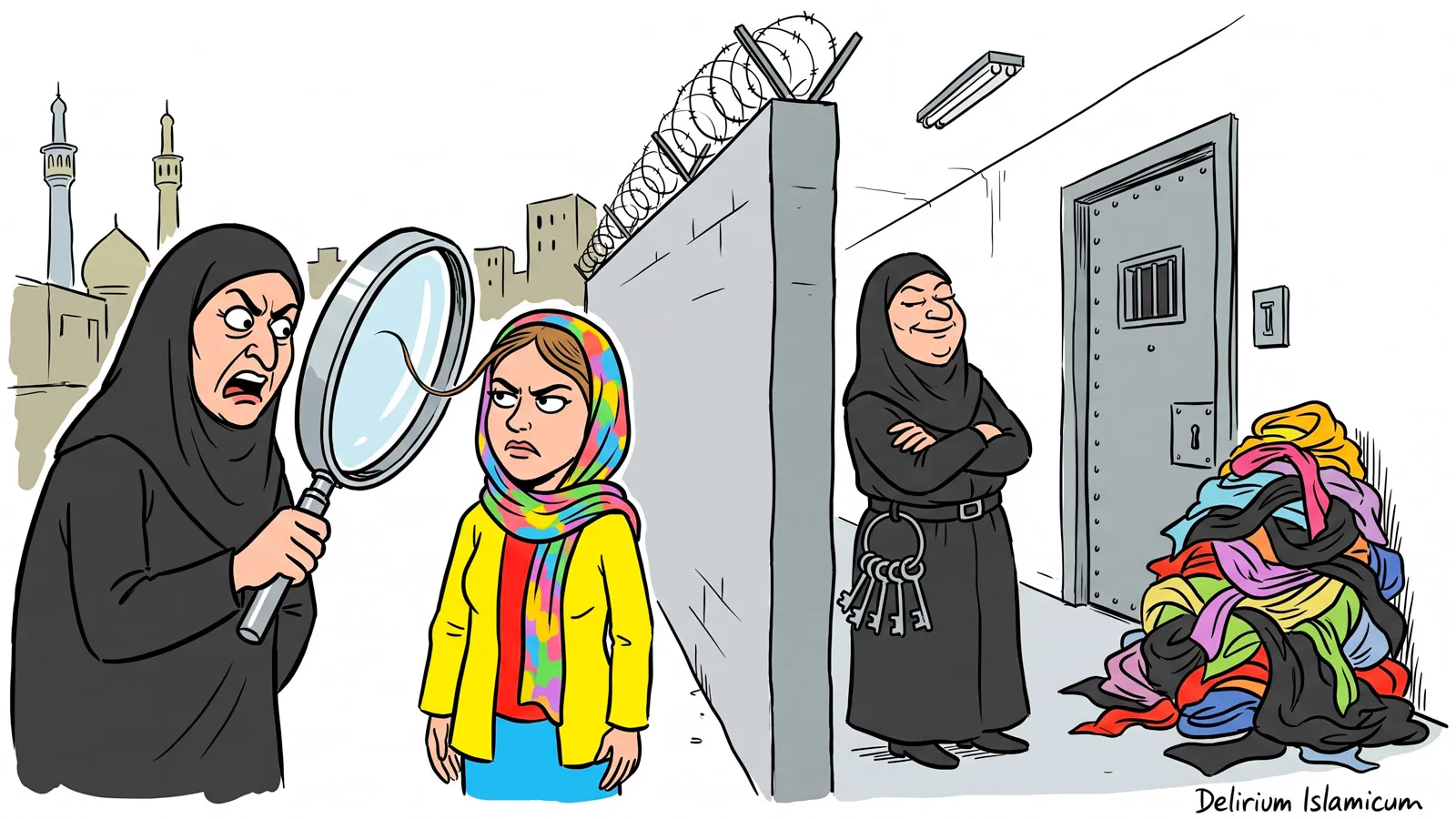
The Islamic Republic will shut a café over an uncovered head and arrest a woman for a loose headscarf. Behind the walls of Tehran's Evin prison, the same state's guards force female political prisoners to undress during searches, according to sources quoted by Iran International. Modesty, it seems, is a rule for women, not for their jailers.
Modesty, enforced in the street
The Islamic Republic takes women's modesty very seriously. Four years after Mahsa Amini died in the custody of the morality police, detained for a supposedly loose headscarf, the UN special rapporteur on Iran, Mai Sato, notes that hijab enforcement goes on, even though the chastity and hijab law was suspended in December 2024. Cafés, restaurants and shops are shut when an employee or a customer appears bareheaded, and arrests are reported. In Isfahan, Rasht and Mashhad, residents say the morality police and plainclothes enforcers are back on the streets. The state has deployed surveillance cameras, drones and a reporting app to protect women's modesty. Inside its prisons, it has other methods.
Undressed behind bars
At Tehran's Evin prison, female political prisoners now face increasingly invasive body searches, including forced undressing and the touching of their breasts, according to sources quoted by Iran International. Many now forgo medical transfers and meetings with relatives or lawyers rather than go through them. Visiting families are searched too: shoes off, mouths inspected, bodies touched. Even children and teenagers visiting a jailed relative are not spared. Women leaving the ward have been made to wear slippers and handcuffs.
Iran's own prison regulations allow searches without clothing only when necessary, and require electronic equipment wherever possible. The sources ask why the scanners are not used. The regulations call for machines. The guards apparently prefer their hands.
Security, the official excuse
The authorities justify the tighter rules by the arrival of more than 40 women jailed for financial offences, who now make up about half of the ward. When prisoners protested the overcrowding in July, special guards answered with batons. Some political prisoners see the mixing as a deliberate policy to break their collective resistance, in a ward that has become a hub of protests and hunger strikes against executions. A demand for dignity, in Evin, is met with a strip search.
Not a first
In October 2024, 22 female political prisoners at Evin had already demanded an investigation into what they called "sexual harassment" during searches. In August, a transgender prisoner wrote from Evin that she had been raped after her arrest in 2023 at an Intelligence Ministry detention facility, then threatened into silence. Former prisoners and rights groups have documented sexual violence against detainees since the 1979 revolution, as a tool of torture and humiliation. In March 2024, a UN fact-finding mission concluded that the crackdown on the "Woman, Life, Freedom" protests involved crimes against humanity, including rape and other forms of sexual violence, and gender persecution.
"We found cases of torture, particularly of sexual violence, gender-based violence."— Sara Hossain, chair of the UN fact-finding mission on Iran, March 2024
Mai Sato, for her part, refuses to despair:
"Those rights will not stay deniable forever."— Mai Sato, UN special rapporteur on Iran, September 2026
In the Islamic Republic, a woman's body belongs to the state twice over: covered by law in the street, uncovered by force in prison. Modesty was never the point. Control was.
Countries
Read also
Kabul Decrees, Geneva Dialogues
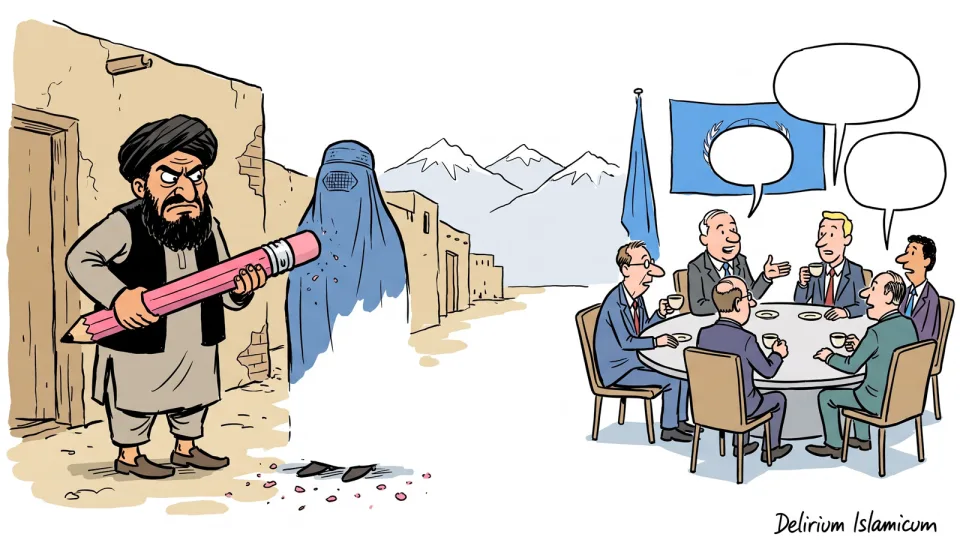
Five years after the Taliban's return, a civil society speaker told the UN Security Council that being a woman in Afghanistan is now a crime. In Geneva, NGOs are pleading with the Human Rights Council to at least keep talking about it: renew the rapporteur, keep the dialogues, launch the investigative mechanism. The rapporteur, for his part, has been banned from the country since 2024.
In Iraq, Marrying a Girl Takes Less Paperwork Than Leaving a Husband
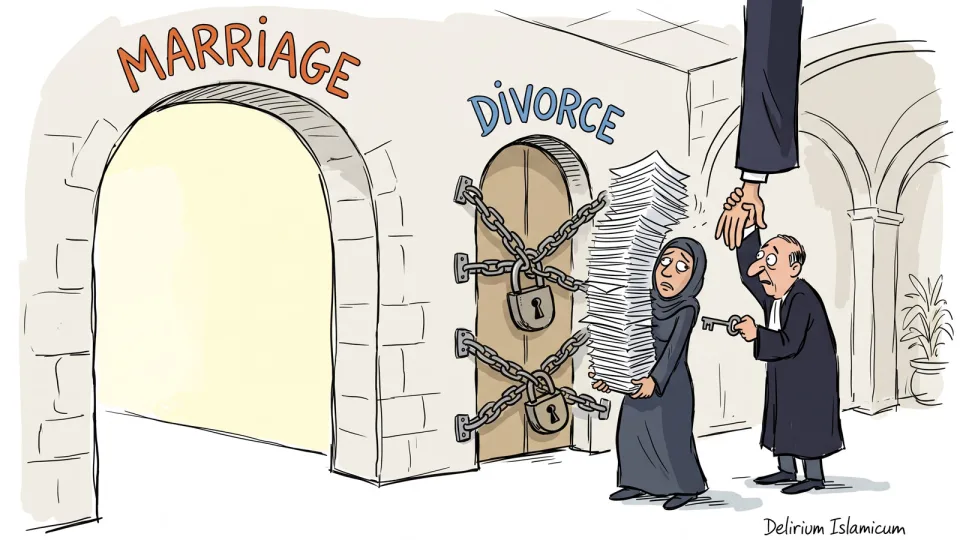
Since 2025, Iraqi couples can trade the civil family law for a Shia religious code. It sets marriage at puberty, accepts weddings with no witness and no register, hands children to their fathers at seven, and lets a woman divorce only if she is abandoned, unpaid or repeatedly beaten. Iraqi women fought to make the reform less terrible. Six months later, parliament made it worse.
Your Death Sentence Is Important to Us. Please Hold.
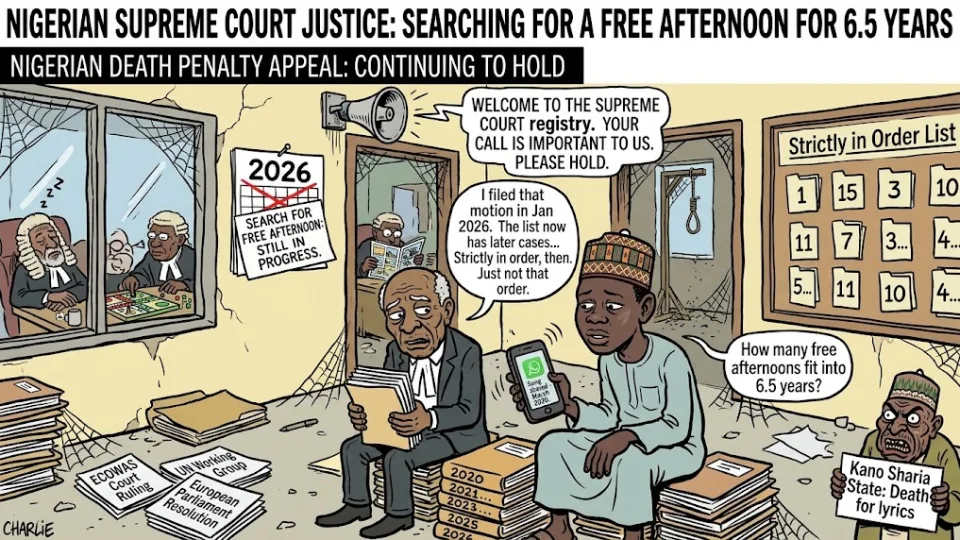
Six and a half years after sharing a song on WhatsApp, a young Nigerian musician is still waiting for his country's Supreme Court to find a slot on its calendar.