
Your Death Sentence Is Important to Us. Please Hold.
Six and a half years after sharing a song on WhatsApp, a young Nigerian musician is still waiting for his country's Supreme Court to find a slot on its calendar.

In most of the world, the worst that can happen when you share a song on WhatsApp is being left on read. In Kano State, northern Nigeria, sharing one got Yahaya Sharif-Aminu arrested in March 2020. His lyrics were deemed blasphemous, a mob burned down his family's home, and in August 2020 an Upper Sharia Court sentenced the young Sufi musician to death by hanging, after a trial in which, his lawyers say, he had no lawyer.
What followed was a masterclass in going in circles. The Kano State High Court quashed the conviction on procedural grounds, then ordered a retrial on the same charges. In August 2022, the Court of Appeal upheld both the retrial and the constitutionality of Section 382(b) of Kano's Sharia Penal Code. His prize for surviving an irregular trial: the right to a second one. Behind bars, without bail, the gallows still on the horizon.
The appeal reached the Supreme Court in November 2022. A first hearing came in September 2025, a mere 34 months later. By November 2025, all briefs were filed and the case was ready. In January 2026, the lawyers asked for a speedy hearing date. The registry told them to file a motion. They filed a motion. The hearing on that motion, set for June 25, was pulled from the list. Cases, the registry explained, are called strictly by filing date. The September to December 2026 list then featured several appeals filed after his. Strictly in order, then. Just not in that order.
On September 14, his lawyers, led by Kola Alapinni, tried again, writing to Chief Justice Kudirat Kekere-Ekun to ask that the case be put back on the list with an early date. Their letter contains a line worth carving above the registry door: in a death penalty case, "delay is not a neutral listing inconvenience."
And this is about more than one man. The appeal tests Kano's blasphemy provision against the Constitution's guarantees of dignity, religious freedom and free expression, and against treaties Nigeria has ratified. A win could set a precedent against blasphemy laws across the north, laws his defenders say endanger religious minorities, Muslims like Yahaya included. According to ADF International, which supports his defence, Kano State officials have said they intend to execute him publicly if he loses. At least someone in this saga is planning ahead.
Meanwhile, Yahaya's catalogue keeps growing. Two European Parliament resolutions demanding his release. A UN Working Group opinion calling for his release and reparations. An April 2025 ruling by West Africa's ECOWAS Court finding the Kano provision incompatible with the African Charter and the UN covenant on civil and political rights, and ordering Nigeria to repeal or amend it. A UN special rapporteur flagging the law after a June 2026 visit. Quite the discography. Only one release is still missing: his.
None of this binds the Supreme Court, the lawyers politely concede. Neither, it seems, does the calendar. They do warn that the world will read further delay as Nigeria dodging the clash between state Sharia codes and its own Constitution. Postponement does seem to be the only verdict this case reliably gets.
Nigeria's Constitution promises a fair hearing within a reasonable time. It took seconds to share a song. Six and a half years later, its author is still waiting for a date.
Please continue to hold.
Countries
Read also
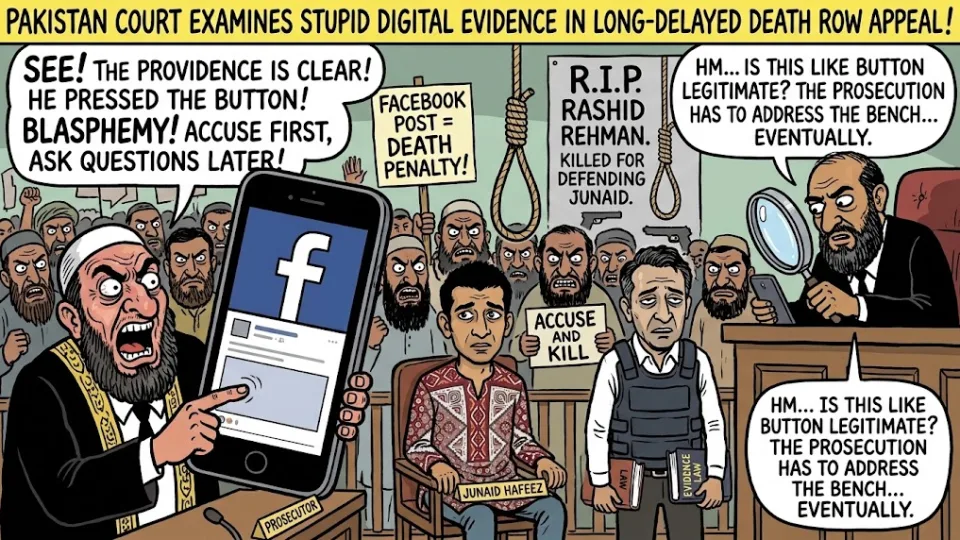
Lahore court finally asks whether Facebook posts count as proof in lecturer’s blasphemy appeal
A Pakistani court has asked prosecutors to justify the admissibility and authenticity of the digital evidence used to convict Junaid Hafeez, a former lecturer on death row for blasphemy since 2019, whose appeal has been pending since 2020.
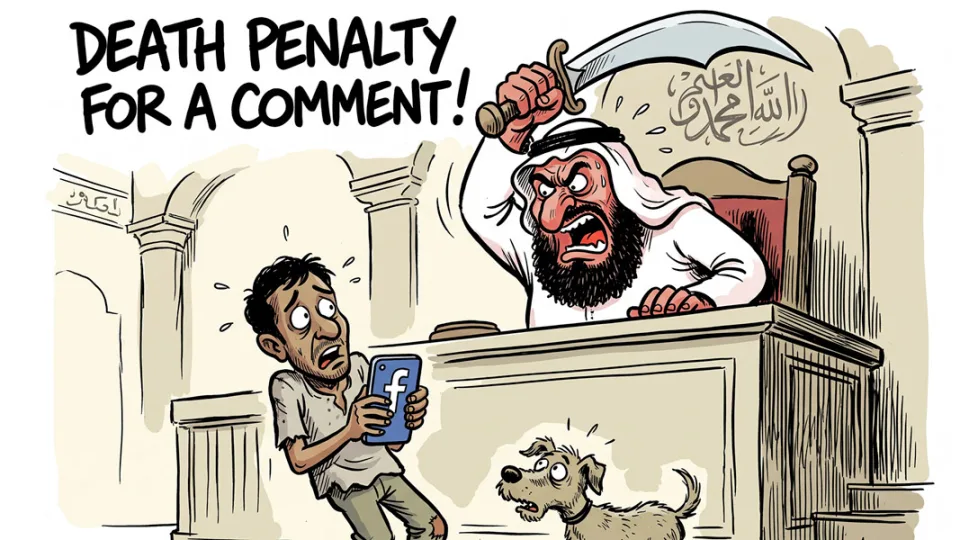
Sri Lankan migrant worker sentenced to death on appeal in Saudi blasphemy case
A Saudi appeals court has sentenced Sri Lankan Tamil worker Sivarasa Anojan to death for blasphemy over a Facebook comment, replacing an earlier five-year prison term. A Sri Lankan MP is now questioning how the government handled his appeal.
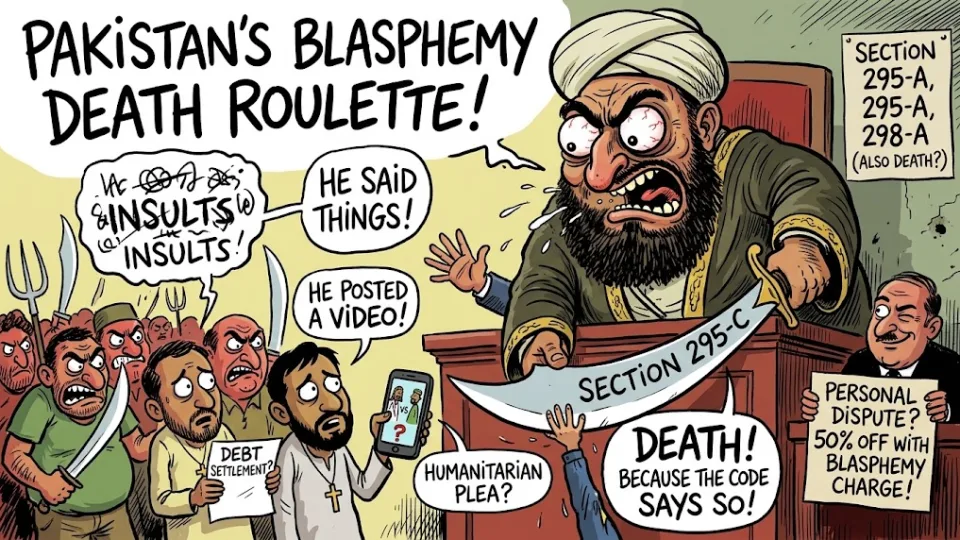
Pakistan's blasphemy laws at work again: two Christians could face death sentences
Two Christians in Pakistan have been charged under the country's blasphemy laws, including Section 295-C, which carries the death penalty. One case involves alleged remarks about Muhammad, the other a social media video.