
Lahore court finally asks whether Facebook posts count as proof in lecturer’s blasphemy appeal
A Pakistani court has asked prosecutors to justify the admissibility and authenticity of the digital evidence used to convict Junaid Hafeez, a former lecturer on death row for blasphemy since 2019, whose appeal has been pending since 2020.
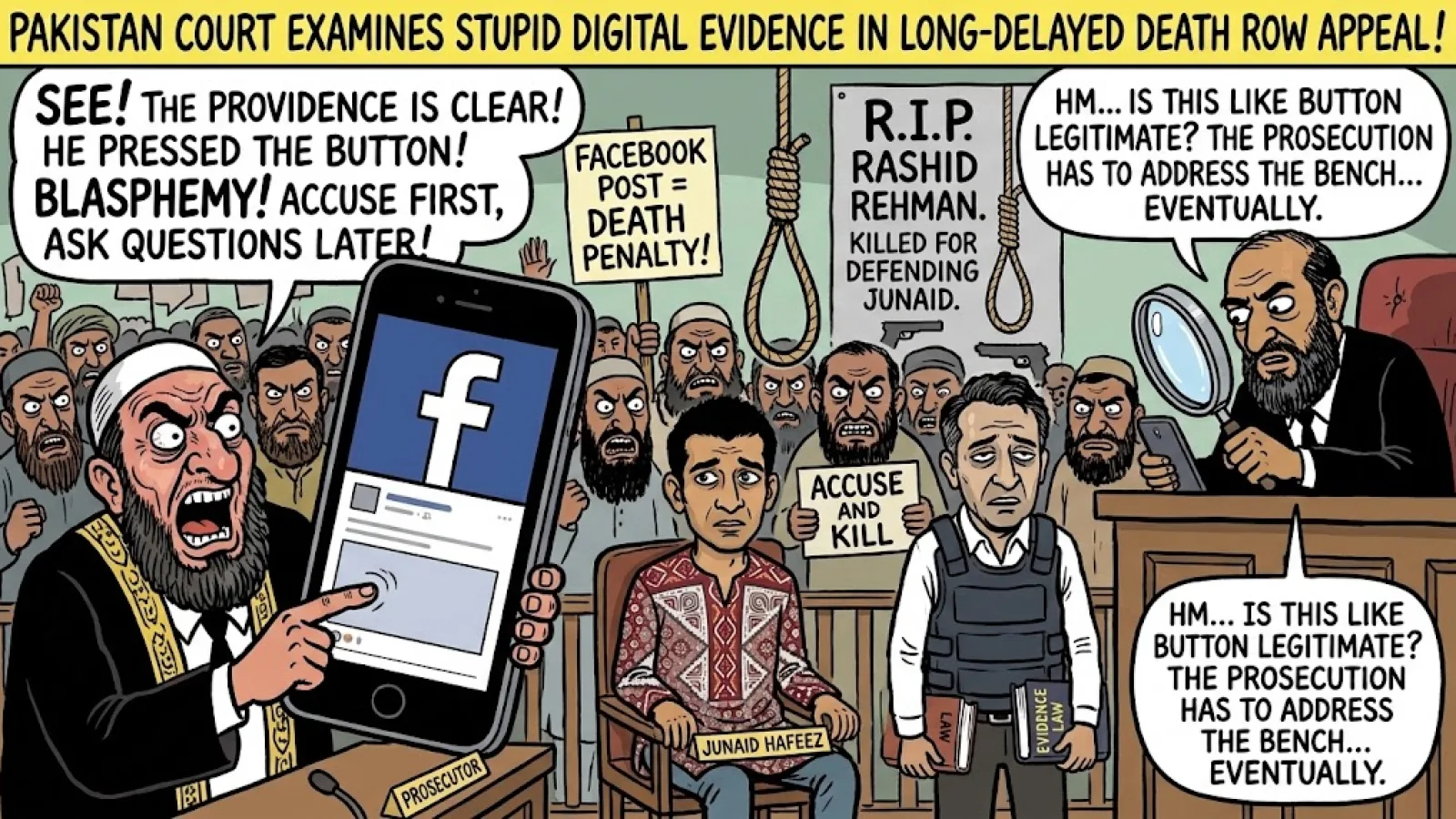
- Former lecturer Junaid Hafeez has been on death row since 2019 over Facebook material he is alleged to have posted
- Blasphemy accusations in Pakistan have led to mob killings, and one of Hafeez’s defence lawyers was shot dead
In a development that deserves to be circled on the calendar, a Pakistani court on Tuesday invited prosecutors to explain whether digital evidence can actually be admitted in the appeal of Junaid Hafeez, the former university lecturer condemned to death for blasphemy in 2019. His appeal has been waiting since 2020, which by the standards of this case barely counts as a delay.
Whether a Facebook page attributed to a man is genuinely his may strike the casual observer as the sort of detail one would want firmly settled when a life is at stake. Still, better late than never.
A law with no room for leniency
Pakistan’s blasphemy laws punish a wide array of acts considered insulting to religion, and anyone convicted of insulting the Prophet Muhammad (pbuh) faces a mandatory death sentence. The state has never executed anyone for blasphemy. It has rarely needed to: accusations alone have set off mob killings, and suspects, their lawyers and others connected to their cases have been threatened and attacked. According to human rights groups, this climate makes it hard for defendants to find legal representation or to receive a fair trial.
From a Multan classroom to solitary confinement
Hafeez was working as a visiting lecturer at Bahauddin Zakariya University in Multan when he was arrested in March 2013 over material allegedly posted on Facebook. Security concerns were serious enough that his trial, which opened the following year, was held inside a prison. In 2014, one of his lawyers, Rashid Rehman, was killed by gunmen after receiving threats for taking on the defence.
After repeated postponements, a Multan court sentenced Hafeez to death in December 2019. The appeal lodged in 2020 was moved from the high court’s Multan bench to its main court in Lahore in 2021, at the defence’s request. Human Rights Watch says Hafeez has been kept in solitary confinement since June 2014.
The prosecution gets homework
On Tuesday, a two-judge bench of the Lahore High Court issued formal notices to the parties and said it expected the prosecution to argue the admissibility of electronic evidence, including a Facebook page attributed to Hafeez. According to defence lawyer Asad Jamal, the judges also asked prosecutors to convince them of the authenticity of that digital evidence. No ruling was issued on either the evidence or the conviction.
I think that significant progress was made today. The court picked up the case, it was called, and beyond that, the court raised the key points that the prosecution must address. The court instructed them to satisfy the bench regarding the grounds raised in Junaid Hafeez’s appeal.— Asad Jamal, speaking to Arab News
“The court explicitly stated that the prosecution must satisfy the court regarding the authenticity of the digital or social media evidence,” Jamal added.
True to form, the next step has already slipped: the bench had considered resuming the hearing on October 7, but set it for October 10 after the complainant’s lawyer requested more time to prepare.
“I am hopeful that a decision on this appeal will be reached very soon,” Jamal said.
Sources
Countries
Read also
Your Death Sentence Is Important to Us. Please Hold.
Six and a half years after sharing a song on WhatsApp, a young Nigerian musician is still waiting for his country's Supreme Court to find a slot on its calendar.
Sri Lankan migrant worker sentenced to death on appeal in Saudi blasphemy case
A Saudi appeals court has sentenced Sri Lankan Tamil worker Sivarasa Anojan to death for blasphemy over a Facebook comment, replacing an earlier five-year prison term. A Sri Lankan MP is now questioning how the government handled his appeal.
Pakistan's blasphemy laws at work again: two Christians could face death sentences
Two Christians in Pakistan have been charged under the country's blasphemy laws, including Section 295-C, which carries the death penalty. One case involves alleged remarks about Muhammad, the other a social media video.