
Waging War Against God, Armed With Stones
Since March, Iran has hanged at least 59 people on political charges, teenagers among them, five of them in public. Their crimes, according to the courts: broken windows, thrown stones, torched motorcycles, all filed under "waging war against God". A UN mission now speaks of crimes against humanity.
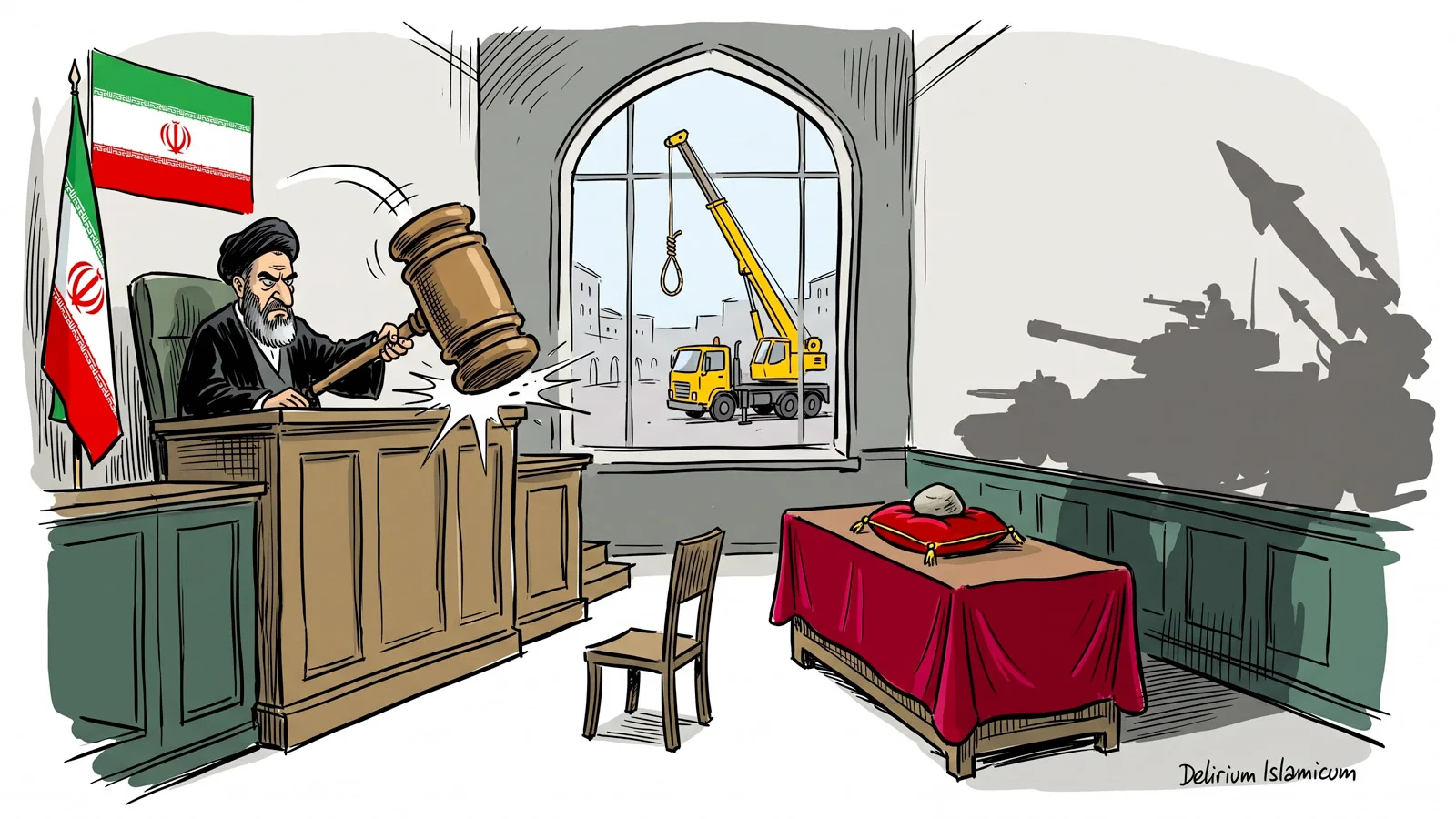
War against God, broken-window edition
In the Islamic Republic, the gravest crimes have the grandest names. "Waging war against God" and "corruption on earth" carry the death penalty, and Iran's judges hand them out generously. Sasan Azadvar Jonaqani, a 21-year-old karate champion, was hanged on April 30 for acts such as allegedly breaking the windows of a police bus with stones and a baton. Amir Hossein Hatami, 18, was executed 84 days after his arrest for breaking into a Basij base, throwing stones and setting two motorcycles on fire. He was not accused of killing or injuring anyone.
Of the 29 protesters executed between March 18 and late August, 16 were not even accused of killing anyone, according to Human Rights Watch and the Boroumand Center. Iran's prosecutor general had set the tone in January: all the rioters, whatever they did, are waging war against God. The Almighty's front line, it seems, now runs through bus windows.
"For God's sake, not execution"
The evidence consists mostly of confessions obtained without a lawyer and, the defendants say, under torture: beatings, electric shocks, mock executions, threats to rape them or their relatives. When Saleh Mohammadi, a 19-year-old wrestling champion convicted of killing a member of the security forces, retracted his confession in court, the judges dismissed his claim because no marks of torture were visible on him. He was hanged about five weeks after his arrest. State television airs the confessions. In one of them, an interrogator tells 18-year-old Shervin Bagherian that he is charged with waging war against God. The young man asks what that means. The answer: execution.
"For God's sake, not execution. Sir, I made a mistake."— Shervin Bagherian, 18, in a confession video aired on Iranian state TV
In Isfahan's Shohada Square case, ten of sixteen defendants were sentenced to death in August, none of them charged with murder. Among them is Taraneh Rahimi, 20. A lawyer in the case has filed a complaint alleging coerced confessions, beatings and sexual assault against her and her twin sister.
Public hangings, and a heart attack
To make sure the message gets through, some executions are staged in public. On July 28, Abolfazl Sepahi and Amir Hossein Safari were hanged in Isfahan's Alikhani Square, where four members of the security forces were reportedly killed in January. Abolfazl's cousin, Alireza Sepahi, was due to hang with them but suffered a heart attack at the gallows. He was taken to hospital, then returned to prison, where he remains at imminent risk. In the Islamic Republic, surviving your own execution earns a postponement, not a pardon. Other families get no warning at all: some protesters have been executed in secret, without a last visit.
Everyone is a spy
When war against God is not enough, there is espionage. A 2025 law toughening penalties for collaboration with Israel and hostile states turned such cooperation into a capital offence and cut the appeal deadline from 20 days to 10. At least eight executed protesters were convicted under it, without evidence of any espionage, according to rights groups. On September 19, Iran hanged Hossein Pedaran, accused of passing information on Isfahan missile sites to Mossad, after a closed-door revolutionary court trial. Rights groups count at least a dozen such executions since the June 2025 war. Official rhetoric casts protesters as foot soldiers of an American-Israeli coup. In Iran, a protester is a terrorist, a Mossad agent or, for convenience, both.
Objecting is a crime too: Tehran's prosecutor has opened cases against people who spoke out against the executions, and at least 19 lawyers were arrested in the month after the January massacres. You can be hanged for protesting, prosecuted for objecting and arrested for defending the accused.
Crimes against humanity
On September 17, a UN fact-finding mission concluded that the crackdown on the protests that began in December 2025 amounted to crimes against humanity: mass killings, torture, tens of thousands of arbitrary detentions and a nationwide internet blackout of more than five months, the longest on record. Some families were asked to pay to recover their dead and pressed to sign statements describing them as agents of the state. More than 70 people, including five women and three boys, are at imminent risk of execution. The same mission also found reasonable grounds to believe the United States committed war crimes, including a strike on a school in Minab that killed about 120 children, so it can hardly be dismissed as a Western tool.
Iran carried out between 1,639 and 2,159 executions in 2025, depending on the count, the highest toll since the late 1980s, when a fatwa by Khomeini sent thousands of political prisoners to mass graves. More than 30 countries, including France, Britain and Canada, have accused Tehran of executing protesters to "silence dissent".
"What we actually have in Iran are arbitrary executions."— Payam Akhavan, former UN prosecutor, August 2026
The Islamic Republic accuses its protesters of waging war against God. Judging by the record, the war is the regime's own, waged against its youth, one public square at a time.
Sources
Countries
Read also
Your Death Sentence Is Important to Us. Please Hold.
Six and a half years after sharing a song on WhatsApp, a young Nigerian musician is still waiting for his country's Supreme Court to find a slot on its calendar.
Lahore court finally asks whether Facebook posts count as proof in lecturer’s blasphemy appeal
A Pakistani court has asked prosecutors to justify the admissibility and authenticity of the digital evidence used to convict Junaid Hafeez, a former lecturer on death row for blasphemy since 2019, whose appeal has been pending since 2020.
Sri Lankan migrant worker sentenced to death on appeal in Saudi blasphemy case
A Saudi appeals court has sentenced Sri Lankan Tamil worker Sivarasa Anojan to death for blasphemy over a Facebook comment, replacing an earlier five-year prison term. A Sri Lankan MP is now questioning how the government handled his appeal.